 |
|
|
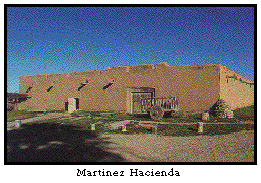
La Hacienda de los Martinez
is one of the few remaining examples of a restored northern New Mexico
style, Spanish Colonial period hacienda open to the public.
This massive adobe casa mayor, or great house, was constructedc sometime
shortly after 1804, by Antonio Severino Martin (later to become Martinez).
The casa mayor that Martinez built became the first permanent, year-round
mercantile operation in Taos.
Summer hours: 9-5 daily
Winter hours: 10-4 daily (November-March)
|
|
|
 |
|
|
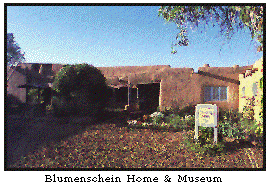
The Ernest L Blumenschein
Home and Museum beautifully represents the lifestyle of the first artists
in Taos. Blumenschein arrived, by accident, in Taos in 1898, with his friend
and traveling companion Bert G. Phillips. Portions of the thirteen-room
home date to 1797, and contain a wonderful blend of European antiques,
Spanish Colonial and regional New Mexican furniture along with an extgensive
collection of the Blumenschein family art and represevtative pieces by
other members of the Taos Society of Artist. The Blumenschein Home is the
only home of a society member that is open to the public.
Summer hours: 9-5 daily
Winter hours: 11-4 daily (November-March)
|
|
|
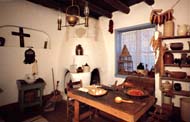
Kit Carson Home |
|
|
The Kit Carson Home and Museum is a complex of buildings
which includes a portion of the original four room home of Kit Carson and
his wife Josefa, an 1855, three-room structure known as the Romero House,
and two, 1952 structures that house the museum's retail shop and additional
exhibition space. Carson arrived in Taos in 1826, at the age of fifteen,
Taos was to be his base of operation and home until just before he died
in 1868. Carson became a trapper and mountain man and traveled extensively
through out the West.
Summer hours: 8-6 daily
Winter hours: 9-5 daily (November-March)
|
|
|
|
Photograph coming
|
|
|
The Morada Centro is one of the most significant
religious sites in northern New Mexico. This meeting house for the Penitentes
is considered to be one of the oldest, largest and most important of the
moradas in the American Southwest. During the early to mid-nineteenth century
the Penitente brotherhood grew in power to become a potent social, religious
and political force in the isolated frontier communities of northern New
Mexico. The Penitentes helped maintain the ethnic identity of the Hispanic
culture during a time in which the area was subject to tremendous social,
political and economic change from without. The building was used until
1969 when only two brothers remained and negotiation to the transfer the
structure to the museums was initiated. At present the Morada houses the
museums archival collection.
Hours: Open by appointment only.
Call: 505/758-0062 or 758-5440
|
|
|
 |
|
|
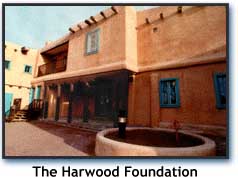
The Library and archives, which form the basis for the
planned collaborative Northern New Mesico Research Center for Taos, contain
sections on Native Americans with a specific focus on southwestern tribes,
Kit Carson literature and archival materials, history and archaeology of
the Southwest, periodicals, research documentation, unpublished manuscripts
and family archives. This research center will be a collaborative venture
between the Kit Carson Historic Museums and the University of New Mexico's
Harwood Foundation Museum.
Hours to be announced.
|
|
|
|
Photograph coming
|
|
|
The Ferdinand Maxell House was built in 1859 and served
as a store and trading post during the American Territorial Period. The
nine-room house is a classic example of territorial architecture with its
uses of milled lumber for floors and exposed, beaded ceiling beams (milled
lumber was not available in Taos until after 1850). Ferdinand Maxell and
his brother Lucien were the owners of the huge Maxwell Land Grant, a 1,700,000
acre Mexican grant that continues to be a source of controversy for the
older Hispanic community. Currently houses Second Phase Gallery. |
|
|